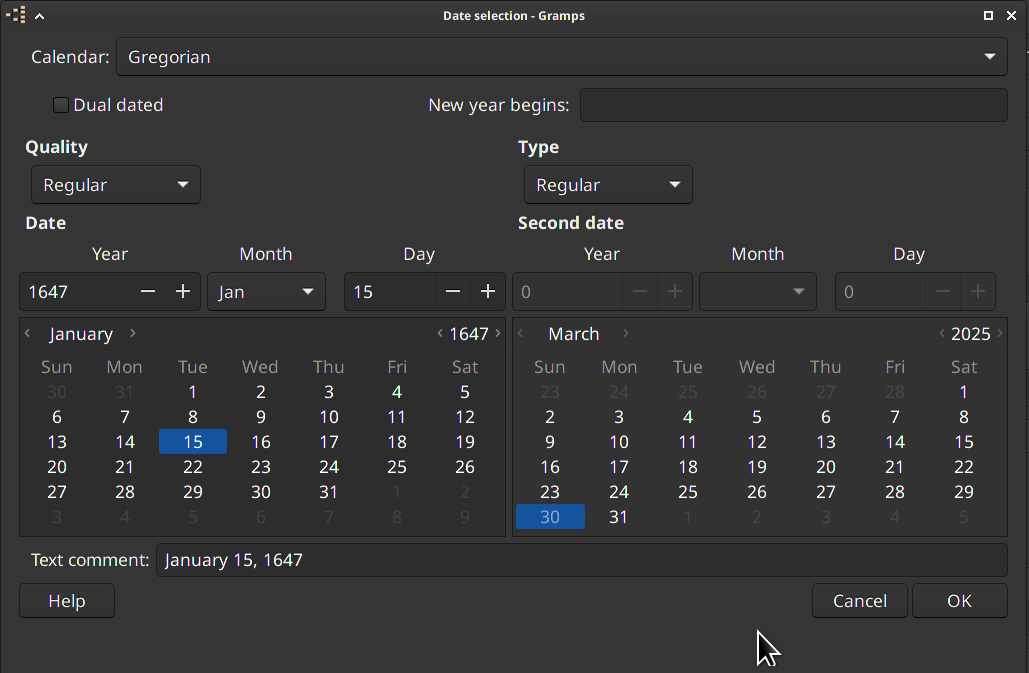
It also seems strange that the GTK widget library doesn’t seem to have a European calendar – where the weeks start on Mondays. [Automatically adjusts to the locality]
I was initially looking at this Gramplet hoping to add « (U+00AB) and » (U+00BB) to move by decades instead of years. But that appears to not be an option either.
Based on other applications (that don’t support spans, ranges or date quality), I had anticipated a simple calendar selector when clicking the “Daily Calendar” gadget beside the Date field. Instead, the more complex “Date Selection” dialog appears.
Perhaps it might be possible to have date field in the Gramplet that is synched to the widget? So that you could jump the calendar directly to a date years in the past?
This would be a useful reference for when hand parsing source record (such as an obit) that refers to day of the week in relative terms to its current date. As in “died Tuesday” in an obituary dated 7 Aug 2021.
I noted that the tooltip on line 48 is inaccurate too. [Filed bug report 12514]
self.set_tooltip(_("Double-click a day for details"))
Double-click actually opens the “On This Day” Quick View. Although the more important tip might be that the day is draggable.
Could the Calendar gramplet be extended to be able to convert ‘church’ dates to ordinary calendar dates?
With ‘church’ dates I mean the date naming like ‘Dominica Quasimodogeniti’. These dates changes from year to year.
I typically use a web site to look up the date for e.g. Dominica Quasimodogeniti in 1783, but it would be handy to have the functionality in Gramps. Maybe the is would be another gramplet?
We can easily create a function that works like: get_date_from_liturgical("Dominica Quasimodogeniti", 1783). But where could we put that in the UI? I don’t think the calendar widget is the right place, and I’m working to try to simplify Gramps overall complexity.
Perhaps we could create theDateGramplet (to rule them all) that packages up all of the great date functions that we have (date math, conversions, liturgical lookups, etc.).
(As an aside, with the Gramps Assistant and the proposed function, you could simply ask it “When was Dominica Quasimodogeniti in 1783?”… no UI needed.)
There is a Custom holiday set feature in Gramps. However, I have never understood the practical application of the holidays.xml.
It would be nice to display as ‘Dominica Quasimodogeniti, 1783’ but calculate using the Unix Epoch value. (This is even more complicated because 1783 was observed according to the Gregorian calendar in most of Europe, but on the Julian calendar in Britain and its American colonies.) Showing the original value as entered in the records would reduce the potential for double-conversions of those dates.
This question piques my interest as I have a similar Calendar problem: the Pennsylvania Quaker colony refused to use Pagan month names and weekday names. They would have used “27 Eighth Month 1730” or “27 8mo. 1730” or “27 viii 1730 o.s.” for “27 Oct 1730 (Julian)”.
In my family, there are a lot of “Quaker Dates” (both Old Style and New Style, although Pennsylvania Quakers were sometimes ragged in adopting Gregorian calendar from the Julian). And if I record the Old Style Quaker date as converted to the more familiar pagan New Style, there is a good chance of double conversions. But if the date is stored with the Quaker Date as a Text string, it cannot be used for date calculations/statistics.
“Dominica Quasimodogeniti” is a church-calendar name for a Sunday, not a fixed civil date. It means the Second Sunday of Easter (or, 1st Sunday after Easter; Quasimodo Geniti; Low Sunday), and its date changes each year because Easter itself changes each year.
In old parish registers, priests often wrote dates by feast day or Sunday name instead of writing a modern calendar date. So an entry might say something like “Dominica Quasimodogeniti” instead of “April 8, 1783,” and you have to convert that liturgical label into the actual date for that specific year.
My first contribution to Gramps was the Calendar report (more than 21 years ago!), and I still print these out every year and give them to my family. The holidays.xml is there for those that want to customize the holidays that show up on the calendar report.
That would tend to explain why I hadn’t noticed it. And there are no representative screen captures in the wiki for those calendars either. So I grabbed one to be included. [ done ]
Here’s a capture of part of the Web Calendar Report for January 2021. (In the US, every 4th January has the most (3) Federal holidays of any month: New Years, MLK day on 3rd Monday, and Inauguration Day on the 20th.) Holidays seem not very noticeable.
Perhaps the holidays.xml might be integrated into the date field parser? So instead of duplicating data in multiple files, Gramps just reuses an existing file? Like the /gramps/plugins/lib/libholiday.py calculates a date.
Alternatively, augment the Date Selection dialog
@SNoiraud has a nice upgrade to the calendar gramplets with Pull 2209. And kindly extended the enhancement to the Date Selection dialog:
Perhaps the Text comment: could have a parser (similar to the Lat/Long coordinates field in the Place Editor or the “Date in Place” parser in the Data Entry addon Gramplet) to look up Holiday phrases in the holidays.xml for the Country of the Place and calculate a date value? (Perhaps with a way to displace the Text comment but use the value for calculations?)
So entering Remembrance Sunday 1995 for an Event in Blackpool, North West England, England, United Kingdom would look up the Holidays in England, find Remembrance Sunday is the 2nd Sunday in November and associate that Date string with the 12 November 1995 date value.